| МОК: | 1 |
| цена: | Customized |
| Стандартная упаковка: | Фанерный корпус |
| Срок доставки: | 30 дней |
| Метод оплаты: | Т/Т |
| Пропускная способность: | 10 комплектов в месяц |
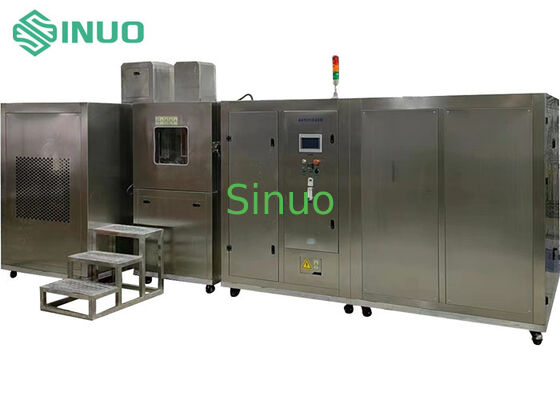
MIL-STD-810G high concentration Laminar Airflow Sand And Dust Test Chamber
Product Overview:
This equipment is suitable for testing electrical and electronic products, automotive and motorcycle parts, and seals in dusty environments to prevent sand and dust from entering the seals and housings. It verifies the performance of electrical and electronic products, automotive and motorcycle parts, and seals in dusty environments during use, storage, and transportation. The purpose of the test is to determine the potential harmful effects of airflow-carried particles on electrical products. The test can be used to simulate open dusty air environments induced by natural environmental factors or human disturbances such as vehicle movement.
Design Principle: A conical funnel with a dust collection port at the bottom is designed. A high-pressure turbine circulating fan is installed at the dust extraction port (on the right side) to draw up the dust and send it to the bottom of the inner chamber, through the bottom to the left side of the chamber, and then into the pretreatment chamber. Dust is blown into the test chamber from the left, and the dust is blown horizontally to the right, thus starting a continuous cycle.
Applicable Standards:
Conforms to MIL-STD-810G, IEC 60068-2-68 etc.
Technical Specifications:
| Chamber inside dimensions | 1000×1000×1000 mm(W×H×D) |
| Approx. Outer dimensions | Approximately 7500×2500×4500 mm (W×H×D) (actual dimensions may vary) including air duct |
| Temperature range | RT±10-80℃ (adjustable) |
| Humidity range | <25%RH |
| Fine dust | ≤75um |
| Coarse dust | ≤150um |
| Concentration | 2±0.5g/m3 |
| Airflow velocity | 5m/s±0.5m/s; |
| Talc dosage | 2-5kg/ m³(This equipment requires 25 kg) |
| Standards | GB2423.37-2006 Test Lc1 / IEC 60068-2-68 |
| Power supply | 380V±10%V (three-phase five-wire, with a separate 80A circuit breaker; the circuit breaker must have terminals; power cord must be at least 10 square millimeters). |
| Pollution, electromagnetic radiation | Meets relevant standards and requirements |
|
Structural method (Integrated controller and test chamber) |
1. The bottom of the chamber is funnel-shaped, with a bottom dust-recovery motor assisting in the dust collection process.
2. The test chamber is approximately cubic, with its side length in the airflow cross-section being at least three times the maximum value of the vertical or horizontal side length of the sample cross-section perpendicular to the airflow direction. The test chamber has a heating function.
3. The test chamber includes a pretreatment chamber, and both chambers have the same airflow cross-section. An air guide vane is installed behind the inlet of the airflow channel leading to the pretreatment chamber. A horizontal laminar airflow is generated through the overall arrangement. A blower device for generating airflow is located at the rear of the test chamber. Air is drawn from the test chamber and sent into the pretreatment chamber through the airflow channel. The dust removal device is external and connected via ductwork.
|
| Exterior wall material | High-quality SUS304 stainless steel |
| Inner chamber material |
SUS304 stainless steel
|
| Observation window | The chamber door has a large observation window. |
| Air duct |
The unique air duct design ensures that the chamber generates a high concentration of laminar airflow.
|
| Basic structure | It consists of a pretreatment chamber, a test chamber, a dust suction port, a dust collection box, a circulating dust blowing device, a vacuum system, a dust storage tank, a flow valve, a heating system, a backflow vane, a sample turntable, a protective mesh, a concentration meter dust return pipe, etc. |
| Observation window | The door is equipped with an observation window, a resistance film heating anti-frost observation window. |
| Lighting | The chamber is equipped with high-intensity LED lighting at the top, which projects light into the chamber through a light-transmitting window at the top; it is controlled by an independent switch. |
| Touchscreen |
PLC and Touch Screen Intelligent Control System (Self-developed by SINUO) |
| Concentration meter |
Analog control signals are transmitted to the PLC module for precise control. |
| Heating system | 316 Stainless Steel Heating Wire |
| Vacuum system | Pressure regulator valve, nozzle, pressure regulator kit, connecting pipe, vacuum pump |
| Controller |
A programmable logic controller (PLC) is used (this controller has a variety of arbitrarily set control functions as described below).
|
| Metal mesh size | Nominal wire diameter 50µm, nominal wire spacing 75µm or less than 150µm |
| Fan | All-plastic centrifugal fan |
Safety Protection Functions:
Equipment Usage Conditions:
Environmental Conditions: The equipment site should be free from strong vibrations, strong electromagnetic interference, high concentrations of dust and corrosive substances, direct sunlight, or direct radiation from other heat sources.
Test System Display:
![]()
|
|
| МОК: | 1 |
| цена: | Customized |
| Стандартная упаковка: | Фанерный корпус |
| Срок доставки: | 30 дней |
| Метод оплаты: | Т/Т |
| Пропускная способность: | 10 комплектов в месяц |
MIL-STD-810G high concentration Laminar Airflow Sand And Dust Test Chamber
Product Overview:
This equipment is suitable for testing electrical and electronic products, automotive and motorcycle parts, and seals in dusty environments to prevent sand and dust from entering the seals and housings. It verifies the performance of electrical and electronic products, automotive and motorcycle parts, and seals in dusty environments during use, storage, and transportation. The purpose of the test is to determine the potential harmful effects of airflow-carried particles on electrical products. The test can be used to simulate open dusty air environments induced by natural environmental factors or human disturbances such as vehicle movement.
Design Principle: A conical funnel with a dust collection port at the bottom is designed. A high-pressure turbine circulating fan is installed at the dust extraction port (on the right side) to draw up the dust and send it to the bottom of the inner chamber, through the bottom to the left side of the chamber, and then into the pretreatment chamber. Dust is blown into the test chamber from the left, and the dust is blown horizontally to the right, thus starting a continuous cycle.
Applicable Standards:
Conforms to MIL-STD-810G, IEC 60068-2-68 etc.
Technical Specifications:
| Chamber inside dimensions | 1000×1000×1000 mm(W×H×D) |
| Approx. Outer dimensions | Approximately 7500×2500×4500 mm (W×H×D) (actual dimensions may vary) including air duct |
| Temperature range | RT±10-80℃ (adjustable) |
| Humidity range | <25%RH |
| Fine dust | ≤75um |
| Coarse dust | ≤150um |
| Concentration | 2±0.5g/m3 |
| Airflow velocity | 5m/s±0.5m/s; |
| Talc dosage | 2-5kg/ m³(This equipment requires 25 kg) |
| Standards | GB2423.37-2006 Test Lc1 / IEC 60068-2-68 |
| Power supply | 380V±10%V (three-phase five-wire, with a separate 80A circuit breaker; the circuit breaker must have terminals; power cord must be at least 10 square millimeters). |
| Pollution, electromagnetic radiation | Meets relevant standards and requirements |
|
Structural method (Integrated controller and test chamber) |
1. The bottom of the chamber is funnel-shaped, with a bottom dust-recovery motor assisting in the dust collection process.
2. The test chamber is approximately cubic, with its side length in the airflow cross-section being at least three times the maximum value of the vertical or horizontal side length of the sample cross-section perpendicular to the airflow direction. The test chamber has a heating function.
3. The test chamber includes a pretreatment chamber, and both chambers have the same airflow cross-section. An air guide vane is installed behind the inlet of the airflow channel leading to the pretreatment chamber. A horizontal laminar airflow is generated through the overall arrangement. A blower device for generating airflow is located at the rear of the test chamber. Air is drawn from the test chamber and sent into the pretreatment chamber through the airflow channel. The dust removal device is external and connected via ductwork.
|
| Exterior wall material | High-quality SUS304 stainless steel |
| Inner chamber material |
SUS304 stainless steel
|
| Observation window | The chamber door has a large observation window. |
| Air duct |
The unique air duct design ensures that the chamber generates a high concentration of laminar airflow.
|
| Basic structure | It consists of a pretreatment chamber, a test chamber, a dust suction port, a dust collection box, a circulating dust blowing device, a vacuum system, a dust storage tank, a flow valve, a heating system, a backflow vane, a sample turntable, a protective mesh, a concentration meter dust return pipe, etc. |
| Observation window | The door is equipped with an observation window, a resistance film heating anti-frost observation window. |
| Lighting | The chamber is equipped with high-intensity LED lighting at the top, which projects light into the chamber through a light-transmitting window at the top; it is controlled by an independent switch. |
| Touchscreen |
PLC and Touch Screen Intelligent Control System (Self-developed by SINUO) |
| Concentration meter |
Analog control signals are transmitted to the PLC module for precise control. |
| Heating system | 316 Stainless Steel Heating Wire |
| Vacuum system | Pressure regulator valve, nozzle, pressure regulator kit, connecting pipe, vacuum pump |
| Controller |
A programmable logic controller (PLC) is used (this controller has a variety of arbitrarily set control functions as described below).
|
| Metal mesh size | Nominal wire diameter 50µm, nominal wire spacing 75µm or less than 150µm |
| Fan | All-plastic centrifugal fan |
Safety Protection Functions:
Equipment Usage Conditions:
Environmental Conditions: The equipment site should be free from strong vibrations, strong electromagnetic interference, high concentrations of dust and corrosive substances, direct sunlight, or direct radiation from other heat sources.
Test System Display:
![]()